
NOTE: This page is still a work in progress, please feel free to share any remarks, photos, or stories about Jay with Communications Specialist McKenzie Meza (mim4@arizona.edu(link sends e-mail))
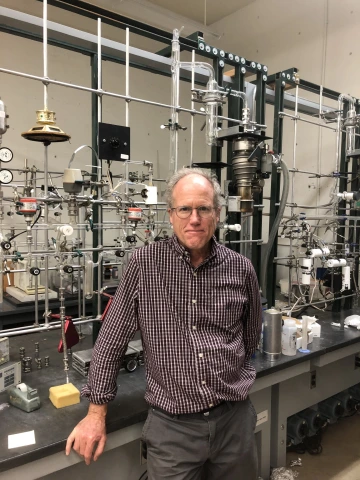
Dr. Jay Quade
Professor
Geochemistry
Deceased October 17th, 2025
Expertise Jay received a B.S. in Geology at the University of New Mexico in 1978, and went on to obtain his M.S. (1981) and Ph.D. (1990) in Geology at the Universities of Arizona and Utah, respectively. Quade joined the faculty in the Department of Geosciences at Arizona in 1992, and has been a Full Professor there since 2003. His interests are in low-temperature geochemistry and paleoenvironmental reconstruction. He has worked all over the world documenting the evolution of climate and landscapes over the past 60 million years, including the context of early hominids in Africa. Quade is has participated in >160 scientific papers, 45 of them as a first author, since 1986. He has received many awards including the Farouk El Baz Award, GSA (2001); GSA Fellow (2015), AGU Fellow (2015), Ben Tor Award from Hebrew University (2014), Geochemical Society Fellow (2017); Arthur L. Day Medal (GSA) (2018), and U.S. National Academy of Sciences (2024)
Please find below a beautiful GSA memorial and official NAS Biographical Memoir both possible thanks to Drs. Julio Betancourt, Thure Cerling, Peter DeCelles, and David Dettman.
^(put together by Jay's daughter Gratianne)^

From Department Head Professor Paul Kapp:
"It is with profound sadness that I share the loss of Professor Jay Quade, member of the National Academy of Sciences. Jay passed this morning after battling Parkinson’s disease. Jay was a real-life Indiana Jones who inspired and elevated all around him. His insatiable passion for discovery—in both the field and lab—made him one of the most influential geoscientists of his generation. He was an exemplary teacher in lower and upper division courses and devoted countless months to teaching summer field camp. Jay was a warm and thoughtful colleague, mentor, and friend. His big smile, infectious enthusiasm, and optimism brightened every room. His wisdom and kindness touched countless lives, and his loss will be deeply felt throughout our community."
Pictured Right: Jay Quade in Nepal, 1996
Pictured Below: Jay being inducted into the National Academy of Science
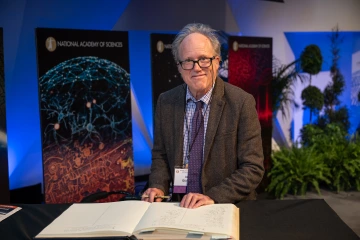
This is a big loss for the Department of Geosciences. With nearly 400 publications, and almost 30,000 citations, Jay has had an extremely influential career. As a 3rd generation geologist, his awards and accolades are nothing short of impressive. Most notably, he was elected to the National Academy of Sciences in Spring of 2024. Prior to being elected to the National Academy of Sciences, Jay earned the Arthur L. Day Medal in 2018 from the Geological Society of America for "outstanding distinction in contributing to geologic knowledge through the application of physics and chemistry to the solution of geologic problems."

Memories from colleagues and friends of Jay:
Pictured Left: Jay and Barbra Quade courtesy of George Davis. taken right after the Day Medal was awarded to Jay
Tribute to Jay from Naomi Levin, University of Michigan:
From April 2005 to April 2006, I had the privilege of being a visiting scholar in the Department of Geosciences at the University of Arizona, where I was hosted by Professor Quade. The last time I met him in person was during his visit to Beijing in June 2006. We remained in contact through email, with our final exchange taking place in June 2024. In that message, he mentioned serving on the advisory board for the journal Quaternary Research and sought my thoughts on its future direction. It’s difficult to comprehend that he is no longer with us. His dedication and kindness will always be remembered, and the time I spent with him in Tucson remains a cherished memory. - Shiling Yang, Insitute of Geology and Geophysics, Chinese Academy of Sciences
From Professor Peter DeCelles:
Image

Grad student Tshering Lama Sherpa (middle) and one of our Nepalese helpers | Image

At a landslide that blocked the road, waiting for it to be cleared |
Jay was such a huge influence on my time at the U of A. I’ll never forget field camp back in 2003, picking up dinosaur bones with him and his son in the Morrison Formation in Utah. I also remember his Quaternary Geochronology class and wondering how much further my brain could stretch on such a complex subject. I always loved the stories he shared about his archaeological adventures in Africa and those early days prospecting for gold in Alaska—hiking up river channels looking for the sources of placer deposits. Every young geologist’s dream job…! He was one of a kind, and his teachings will never be forgotten. - York Lewis, B.S. Geoscience, 2024
Jay was a beacon to me for more than 20 years. Personally, and professionally. I learned so much from him and loved being with him, whether in the field or in a coffee shop. Its difficult to imagine this world without him. Our collaboration started in 2004 when he invited me to work with him in the Atacama Desert. Since then, we worked together in several deserts in the world. Jay spent several months at the Hebrew University in Jerusalem. During that time we developed the ideas that are currently at the base of our mutual research project, in which we also have been sharing the supervision of PhD student. In 2023-2024 I was was lucky to spend a 6 month sabbatical with Jay in Tucson. Below are several photos of Jay and other researches. Jay left us a legacy of curiosity, inquisitiveness, and awe of the world around us. Scores of students, including me, now positioned all over the world, will remember him and will spread his spirit. - Ari Matmon, Institute of Earth Sciences, Hebrew University of Jerusalem
Image

| Image

|
Image

| Image

|

I used to work as a graduate student for Paul's Suture Zone project with Peter Lippert and Guillaume Dupont-Nivet and that was the time I got to know Jay. I moved to Tucson as a postdoc from 2015 to 2017, and got to know Jay better. We had collaboration even after I moved to Rochester in 2017 and back to China in 2021. When I was visiting Tucson in November 2023, I had a meeting with Jay at the lunch time and we talked about the hydrothermal events that I identified in the Himalayan rocks with the help of the carbonate clumped isotope data acquired in his lab. I was surprised at that time that Jay was not in good health as he was in 2017 when I moved away to Rochester. I thought that his Parkinson’s disease was stable and in good control. I did expect things were going worse so quickly.
The first time when I met Jay in 2011 in the field, he told me that the a critical section that we studied to constrain the palelatitude of Eurasia southern margin was afected by hydrothermal alteration. Proving this and correlating it to remagnetization of these rocks took us lots of effort, and that was the most important part of my PhD and Postdoc projects which Jay contributed significantly.
Jay is a great person to be a friend and mentor, I feel lucky to have known and worked with him. Please take my deepest condolences to his family. I have been and will always by inspired by his kindness in personality and passion in geology. Below are some photos in Tibet in 2011 when I first met Jay. He was healthy, strong and nice to everyone as always. May Jay rest in peace and no sickness in heaven. - Wentao Huang from the Institute of Tibetan Plateau Research
Image

| Image

| Image

|
Image

| Image

| ← Photos shared by another colleague, Shun Li. |
I was Jay Quade's graduate student from 2011 to 2015. I'm super sad to hear of his passing. He was a great and beloved mentor to me. Probably the greatest boon is that at one point in grad school Jay asked me to scan some black and white photos of his days running track at University of New Mexico when he was in college. - Adam Hudson
Image

| Image

| Image

| Image

|
Jay has been my greatest teacher and mentor, and an invaluable friend. He is the scientist who had the most profound influence on the way I practice science today. Not a week goes by without me thinking of him.

I was still a young and inexperienced French PhD student when I asked Jay to be part of my dissertation committee in France. To my surprise, he responded quickly and positively, and even flew all the way to Poitiers for the defense in 2013. When I asked if he would host me at UA for a one-year postdoc, he accepted without hesitation. Just a few days after my arrival, Jay drove me out to Pahrump, Nevada. It was the second town in the US I had been after Tucson, and it was both an amazing fieldtrip and a cultural shock. He knew every single arroyo, outcrop, and countless stories about weird guys he encountered during his years of fieldwork in the area. On the way back, we decided to go off the beaten path, he had me plant my tent on icy ground somewhere in northern Arizona, it was the middle of January. The full wild west package in less than a week.
During my year at UA, we spent days and days scouting southern Arizona sedimentary basins for suitable outcrops – officially for a paleoaltimetry study, but unofficially just to be out in the field, climbing remote mountains and investigating odd spots on the geological map. I remember the countless fire camp stories he would tell us in the evening. The forgotten crashed plane in the forest, his PhD years living with his wife and kids in a van in the middle of Nevada, the dead body in the middle of the desert, or the time he left his sherpas behind to climb a >7000 m mountain in Tibet. I remember that he was an incredibly fast hiker, always ahead of anyone while we were out in the field. Keeping pace with him was a real challenge. His daily runs up the stairs in Gould Simpson (twice per day, and eight times at the end of the week, if I recall correctly) significantly contributed to build his reputation of physical powerhouse. We brought one of his prospective master’s students for one afternoon of fieldwork in the Tucson Mountains, and we ended up stuck in a forest of jumping and teddy bear Chollas, with both of us having multiple cholla stems stuck to herself; in the meantime, he was hopping from rock to rock, untouched by the cacti. Only once I manage to outpace him during a field day, and it was no small victory for me (I can even tell that it happened in the Chiracahua Mountains). I don’t think I’ve ever seen him tired after a day of work.
I sometimes wonder if there is a place or a geological basin Jay hasn’t touched, because every time I start a new project, I discover afterward that he has already worked nearby or on a similar topic. He probably passed on to me his fascination with the same geological features, and I now find myself drawn to the same regions and research topics that captivated him. It’s actually quite a challenge, because his scientific papers always set the bar so high, forcing me to rethink everything I write or do, just to make sure I can keep up with his previous work.
It goes without saying that I learned a lot with him during my short stay in Tucson. But it’s not the science I cherish and remember the most: it’s these times when we went looking for scorpions under the moonlight, the lunch breaks in the basement of Gould Simpson (the big and dark place where Adam Hudson, he and I were the only occupants) when we would discuss about foreign politics and ancient history, or the unusual things he’d cook over the fire pit and have us taste for dinner (he introduced me to s’mores), and all the little moments that made my life in Arizona so rich and so much fun.
We stayed in touch over the years and continued to meet regularly until I moved back to France in 2020. I have been saying many times that if I ever move back to the US, it would be in Arizona, and that’s because of him. Jay’s impact on me is beyond measure and it has already been passed on to the next generation of students. And yes: I try to outrun them in the wilderness, make them camp in impossible places, and tell them wonderful campfire stories, some of which feature Jay, the crazy American geologist. - Alexis Licht
Here is one of my favorite "aha!" moments with Jay collaborating in the Atacama. We were close colleagues and friends for more than 40 years.

Jay Quade is truly outstanding in the field, where his many colleagues and students across multiple disciplines rely on his acumen, and often scurry after him for fear of missing seminal discoveries. Here’s my favorite anecdote about working with Jay in the field. In 2004, Jay and I were sampling soils every 350 m in elevation from sea level to 4500 m in the Atacama Desert of northern Chile. Our ~200-km transect crossed large expanses with and without vegetation, the latter regarded Absolute Desert. One of the questions we had was whether plants had ever invaded Absolute Desert. We decided to test this by analyzing carbon isotopes from soil carbonate. If the isotopic content of the carbonate was in equilibrium with the atmosphere, basically around -8‰, the answer is no. However, if the isotopic signature of the soil carbonate mirrored that of C4, CAM, or C3 plants, specific areas in the Absolute Desert must have been vegetated at some time in the past. As we traversed the transect, often driving cross-country in the Atacama, we (Jay) made the following discovery. Soils in currently vegetated areas along the Pacific coast, supported by fog, contained carbonate. The same held true in the sparse shrublands and grasslands at the highest elevations. Expanses without carbonate included intervening and rainless areas of Absolute Desert, and areas above 4500 m, the present cold limit of vascular plants. Sampling a soil pit in the Absolute Desert, we had the following conversation.
Jay: “Julio, I think our hypothesis was totally wrong.”
Julio: “No soil carbonates again?”
Jay: “Yeah. You actually need plant root respiration to build soil carbonates. There are no soil carbonates here because there are no plants.”
Julio: “I think I know where you’re going, Jay”
Jay: “Soil carbonate is the chemical signature of plants on Earth. When we get home, we’ll survey the literature for the first defensible calcretes in the geologic record.”
Julio: “Has to be after the Silurian with the origin of land plants, right?”
Jay: “That’s right.”
Our conversation the rest of that day ranged far and wide, from the impact of pedogenic carbonates on atmospheric CO2 levels throughout geologic history to the possible meaning of carbonates found on Mars. For me, collaborating with Jay in the field was a gift from heaven. - Julio Betancourt, Scientist Emeritus, USGS, Reston, VA
I collaborated with Jay on research in the Atacama Desert in Chile from about 2012 to 2019. Research collaborations with Jay were so rewarding due to his infectious enthusiasm, insightfulness, and keen intellect. His loss is a loss for all of us. Here are a few photos of time spent together conducting research in the Atacama Desert in Chile. - Julie Neilson, Research Professor Emerita of Environmental Science, University of Arizona
Image

| Image

| Image

|

Image

Making sparks | Image

Checking out the Carbonates | Image

Getting to the bottom of it with Jordan Abell | Image

Warming up |
Below is my tribute to Jay Quade, which I circulated in Anthropology to our Anthropology students, faculty, affiliates and friends. I know that this would be just one of many written in celebration of Jay's life, but it relates to his interdisciplinary nature and the tremendous appreciation that we have for him. Jay and I were close colleagues and friends throughout his time at UA, and he did a great deal for Anthropology at many levels as well.
Image

Tabernacle Hill, UT - 1993 | Image

Jay and Emeric just below White Mountain Peak, CA - about 3800 m altitude (about 12,500 ft). | Image

Jay just below White Mountain Peak, CA - about 3800 m altitude (about 12,500 ft). |
One memory I’ll always cherish is when Jay, Andy Cohen, and a few of our colleagues went to sample the Verde Formation near Clarkdale, AZ, in September 2022. I took my then 10-year-old son with me. At the outcrop, Jay asked Zander if he had ever looked at carbonates through a hand lens, then invited him to give it a try. He showed him how to safely crack open a sample and look for specific fabrics. After that, my son happily whaled on rocks and searched for clues with Jay’s lens for a solid hour. I got a big smile out of that — and with Jay, the whole thing happened effortlessly. - Brian Gootee, AGS

Several of us were fortunate to meet Jay Quade in 1978 at Indiana University’s field camp in the Tobacco Root Mountains, Montana. Even then it was crystal clear that Jay was an amazing individual – a rare combination of insatiable curiosity, endless energy and vast knowledge bundled in a fun-loving, humble conversationalist. Long challenging walks and many engaging discussions were memorable. Jay was an influential role model for many of us at field camp and continued to be an inspiration throughout his exemplary career. His ability to be scientifically thoughtful, open-minded, and rigorous while being generous and accepting was a defining characteristic from the field camp days through to meetings for coffee in recent years. Jay did amazing things for many people over his career; we have lost a valuable colleague way too early. - Bill McClelland, Professor Emeritus, University of Iowa
Pictured: Jay Quade and Bill McClelland at Logan Pass, Glacier National Park on a 1978 field trip during field camp. Photo by Jane Gilotti

I’m so sorry, Jay was one of the great ones and he will be sorely missed. I really thought, and wished, he would have more time with us. Here is a collection of student recommendations that were submitted for a Graduate Teaching and Advising Award that Jay won (of course he did!), it is filled with student memories and indications of what an amazing teacher and mentor Jay was to many. I’ve also included a satirical magazine cover I made for the same event. I’m grateful I shared these with Jay earlier this year. It's not an exaggeration to say that I wouldn’t be where or who I am today without Jay’s mentorship and friendship. He was wonderful, kind-hearted, funny and smart as and he will be missed. - Nathan B. English
Image

Jay at a standoff with kids in Nepal | Image

Jay in Nepal | Image

Jay getting directions | Image

Jay on the Tarai | Image

Jay and Pete Kaminsky and porters |
Image

Jay titrating on the Seti River | Image

"Which trail is fastest?" | Image

Jay crossing the Seti River
| Image

Jay the one sock wonder! |

Image

Jay sampling paleosol carbonates at Puerta de Corral Quemado, NW Argentina, January 1994 | Image

Jay checking out plant facilitation in the Monte Desert, NW Argentina, January 1994 | Image

Jay and Barbra Quade sampling in NW Argentina, January 1994 | Image

Jay, Claudio and Don Victor Pérez (middle), owner of the estancia at Puerta de Corral Quemado, January 1993 |
Image

Jay feeling at home at Puerta de Corral Quemado, NW Argentina, January 1994 | Image

Jay checking out soil exposures, NW Argentina, January 1994 | Image

Jay’s car wreck, Paso de San Francisco, Chile, January 1994 | Image

Jay looking for (and finding) rodent middens in the Atacama Desert, Chile |
In 2010 and 2011 I had the great good fortune of spending time with Jay in Tibet. Although I had known him for some time previously, it wasn’t until 2010 during our first period of “forced association” that I fully realized the depth and breadth of Jay’s knowledge and his intuition as a scientist. I will always appreciate how much I learned from Jay simply by working alongside him in the field…and during the endless days spent with him in a Toyota Landcruiser discussing matters ranging from the sublime to the ridiculous. Thank you, Jay! Fare thee well! - John Olsen, University of Arizona School of Anthropology
Image

Jay and drivers exhausted at lunch in Tibet, 2010 | Image

Jay at Neolithic archaeological site in Tibet, 2010 | Image

Jay at Neolithic archaeological site in Tibet, 2010 | Image

Jay resting, Rinqin Xibco, Tibet, 2010 |
I had the great pleasure and privilege of knowing Jay from the age of 7 until his passing. He was like a brother to me, and although we are approximately the same age, I have always looked up to him as a person with superior intellectual capacity and unassailable integrity. More importantly, even in our miss-spent youth, Jay treated others (almost all of whom were his inferior in one way or another) with compassion and kindness.
When we were in grade school, I never had to read much about ancient history, archeology, or geology because Jay had already done the research and was a veritable font of knowledge. He was already a good teacher by the age of 10!
One anecdote that shows not only how Jay sometimes conveyed knowledge in a (somewhat) practical way while also having fun at the same time occurred in the 6th grade at Huffaker Elementary school in Reno. Jay was studying Roman history (on the side) and decided it would be a good idea to re-enact a battle between the Romans and the barbarians. I don’t think he had a specific battle in mind, but with my feeble assistance we somehow convinced the entire 5th grade to portray the barbarians while the 6th grade took on the role of legionnaires. At recess, we lined up on opposite sides of the playground and the battle commenced. I’m fairly sure that it rapidly devolved into an undisciplined battle of barbarians against barbarians, but what I know for a fact is that the school principal soon came out to observe. I think he was impressed with Jay’s teaching technique and even though our weapons were imaginary and all injuries were minor, still decided that a truce was in order and that the battle should never be repeated while he was principal of the school. It never was, but I’m still grateful to Jay for making that particular school day so memorable.
Jay and I shared a love of family, friends, music (Jay was at one time a competent violinist and I still dabble at cello), humor, history, and science. I consider myself very lucky to have known Jay and believe that he made the world a much better place. - Peter Lenz
Image

| Image

Angel Lake 2015 | Image

Jay Quade E. Humboldt Range 2015 |
Image

Jay Quade E. Humboldt Range 2015 | Image

Jay Quade E. Humboldt Range 2015 | Image

Steele Lake 2015 |

I had the great pleasure of meeting Jay during the 2018 Gona field season in the Afar, Ethiopia. Leading up to 2018, I had worked with the Gona archaeological team for three years measuring section. Over lunch and dinner, epic stories were recounted of Jay mapping the Busidima Formation in his Teva sandals while only having a few grapefruit for lunch. Of course, never having met Jay I just assumed the stories were exaggerated. As one can see from reading this Memoriam page, that couldn’t be further from the truth.
I vividly recall getting ready for our first field day in 2018. Jay emerged from his tent and walked over to me in his Teva sandals to show me his extremely old/turn of the century Brunton compass handed down to him that he had been using to measure section. I found this fascinating, however I couldn’t help but to recall all those Teva sandal stories and so I glanced down at his feet and asked him, “you are going to map in those?!” He smiled and eagerly explained the how/why he switched over to sandals – to eliminate blistering. At this point I knew I was in for a memorable field campaign. Ten minutes later as we made our way to the Landcruiser, I watched from a distance as Jay scurried over to the supply tent only to reappear thirty seconds later with two grapefruits in hand. Jay spotted me, walked up to me and professed that he doesn’t like to take lunch in the field (only makes you thirsty) and prefers to just eat a few

grapefruit. And so began my epic adventures into the Busidima Formation with Jay Quade. Although those moments and the ones that followed were far too short, I learned so much from Jay and I count myself as one of the lucky ones to have crossed paths with such an amazing scientist and all-around great guy.
Pictured are Jay during the 2018 field campaign at Gona, Ethiopia, reuniting with local Afar guide, Asa Hamet. Asa Hamet was right by Jay’s side for much of his earlier geologic mapping efforts at Gona (1990s-2006). - Gary E. Stinchcomb, University of Memphis
Image

| Image

| Image

| Image

|
Jay and I grew up together outside of Reno, Nevada. We had many adventures and were intermittently best friends before we largely lost touch (regrettably) when he moved to Arizona to pursue his love for all things ancient and earth and I, a career in Medicine.
Reading the accolades from his contemporary colleagues reminds me of the Jay Quade I knew.
We spent long hours outdoors hiking in the Sierras or Ruby Mountains, playing broom hockey on his family’s frozen pond, spelunking (photo, Jay far right) and working to complete a 44 ft Ketch to pursue our dream (short lived) to sail the seven seas (photo, Jay far left and his father, Jack, far right).
We spent one summer digging a horizontal tunnel deep into plowed dirt and rock behind my house. When our fathers became aware of what we were doing and recognized how unstable the dirt was, they insisted we shore up the sides and roof with timbers, which gave it the awesome feeling of a mine shaft. They also forbade us from going any deeper. Knowing the tunnel was likely too small for them to enter, we decided the next best step would be to dig down vertically at the far end of the tunnel to create a cavern that could not be seen from the tunnel entry. It didn’t take long for them to note the additional dirt coming out of the tunnel, figure out what we are doing and permanently collapse the entry. In retrospect, we were glad they did before it became a death trap.
As Jay’s field students can probably attest, our hikes were often more arduous than the rest of us had intended. Jay always took the lead which steadily grew as the day progressed despite our attempts to slow him down. Adding rocks to his pack had no effect. (photo, Jay second from the right in the front row, I with the sun hat).
Jay had little interest in the comforts of life or the latest gear and seemed to be void of the gene for suffering. Photos shared separately by Peter Lenz show Jay guiding our group as adults to Steele Lake in the North Humboldt Range. What Peter may have failed to mention is that Jay took us across boulder fields (photo below) wearing a pair of worn out Tivas duct taped to his feet.
I was frequently stunned by his powers of observation finding things on hikes when the rest of us only saw dirt, rocks and sagebrush. He would often pick up an obsidian fragment exclaiming it had been part of an arrowhead. My skepticism was usually overcome when he would soon find a complete arrowhead.
Being pals with Jay was never boring. He was fun to be with and taught me a lot about ancient battles, geology, archaeology, dedication to learning, and austerity. I am grieved by his premature demise but am heartened by the impact he had on me, his profession and so many others around the world. - Jay Betz, MD
Image

| Image

| Image

|
Jay was my PhD advisor between 2015 and 2020. During my time in grad school, I had the privilege of not only having a top-class scientist as a mentor, but also a kind and incredibly wise human being as a friend. There are countless lessons that I got from Jay, but one that I kindly remember came from a common day in the lab. We were working on the 14C lab, trapping CO2 in glass tubes when suddenly one part of the glass line just broke off. Repairing that would not only require the assistance of a technician, but it also would take a couple of days. Thus, I naively thought that it was the end of the lab work for that day (it was Saturday). I imagined spending the afternoon watching a soccer game or finishing a Sherlock Holmes novel that kept me captivated by that time. However, Jay had other plans: he said that we should take the opportunity to clean and replace some copper wires that remained exposed, a task that eventually took us the entire afternoon. That day Jay gave me a valuable lesson: look at for opportunities in each scenario that crosses your path.
Paul Kapp mentioned that Jay was a real-life Indiana Jones, and that is not an exaggeration considering Jay’s outstanding physical skills that took him around the most prominent landscapes in the world (regions such as the Tibetan Plateau, the Central Andes, the North American Cordillera, or lakes, deserts and mountains in Turkey, Ethiopia, Australia, Southern Europe, among others). However, for me he was also a real-life Sherlock-Holmes. His sharp observations in the field combined with his extraordinary abilities to understand complex data and passion for knowledge were the perfect combo to solve intricate geological puzzles.
In Jay we have had not only a mentor and a scientific role-model, but also a supportive force who influenced us to become better human beings. His legacy has transcended geographical, ideological, and generational boundaries. We, who had the bless to interact and work with him, have the responsibility of passing that legacy not only to the coming generations of geoscientists, but also to the people around us. Finally, I just want to quote some lines from Sir Arthur Conan Doyle that describe in simple words my admiration for Jay: “whom I shall ever regard as the best and the wisest man whom I have ever known”.
Thank you Jay for your commitment with knowledge and for helping to shape the minds of a generation of geoscientists. - Sebastian Jimenez-Rodriguez
Jay and I overlapped in Thure’s lab during our graduate school days, and I feel very fortunate to have known him. He was a wonderful lab mate, a dear friend, and an outstanding scientist whom I always looked up to.
One of my fondest memories of Jay dates back to that time. In my third year of graduate school, Thure sent me to the San Pedro Valley in Arizona to collect paleosol carbonates from stratigraphic sections that Gary Smith was measuring. Jay joined me there for a couple of days to teach me how to identify paleosols in the field. We would start from the same spot each morning, but before long he would be far ahead, moving quickly across the landscape in search of good exposures, while I tried my best to keep up. Once he found a good section, he would always wait and take the time to show me what to look for and how to sample properly. I still remember how exhausted I felt at the end of those days, but also how much I had learned and how much I admired his energy, expertise, and generosity.
Jay was just as remarkable in the lab. When I first began working on fossil teeth, he patiently guided me through sample preparation for stable isotope analysis. He was exceptionally skilled, meticulous in his work, and always willing to share his knowledge.
Jay made a lasting impression on me, both as a scientist and as a person. It was a great privilege to have known Jay. I miss him deeply. He will be remembered by many who admired and respected him. - Yang Wang, Florida State University
In the late 1990s and early 2000s, I had the great privilege of working with Jay Quade, Pete DeCelles, and Tank Ojha in Nepal. Through several field seasons, I gained a healthy respect for Jay’s physical speed and endurance. Like all of us who worked with Jay in the field, I learned that Paul Kapp’s description of Jay as “a real-life Indiana Jones in sandals” was spot on.
My most treasured memory of Jay is the field season I shared with him and Naomi Levin in the Afar Rift of Ethiopia. My task was to sample the hominid fossil and stone tool bearing deposits of the Gona Paleoanthropological Research Project area to establish the magnetostratigraphy. Through weeks of field work, I managed to learn the basic geology of the Gona region. But my vision of that geology was a fuzzy black-and-white static image. Jay was seeing the geology in high-resolution technicolor. And he had a time-travel dial he used to transport us back in time so he could describe the paleoenvironment of every unit. The depth of Jay’s knowledge of the Gona geology was a marvel to me.
Jay’s mental breadth and tenacity were phenomenal. The range of his interests was extraordinary, and he clearly believed that every important geological puzzle was solvable. So, he solved them one after another. As Naomi Levin said: “For Jay, nothing was out-of-lane scientifically.” Jay’s child-like curiosity reminds me of the saying attributed to John Muir: “When one tugs at a single thing in nature, one finds it attached to the rest of the world.” Jay pulled on many geological strings and discovered many attachments. I will forever remember Jay’s infectious enthusiasm and generosity, as well as the image in my mind’s eye of him disappearing up the trail ahead of me. - Bob Butler, University Distinguished Professor Emeritus
When I arrived in Tucson in 1993, Jay asked if he could "deputize" me to help maintain his new lab. I was honored and thrilled and of course said yes. Looking back now, I think that was the greatest honor of my lifetime and yet it was just one of so many opportunities he gave me. One of my favorites was learning and helping with 87Sr/86Sr labwork in Jonathan Patchett's lab.

1993: geochronology field trip to El Malpais volcanic field, NM. From left to right, Jane Potts, Bill Phillips, Nat Lifton, Jay Quade, Thure Cerling and Bill McLaughlin.
Jay was never my official mentor, but he shaped me deeply as a scientist and a person. He had a preternatural ability to notice what was important about each outcrop and to find the best samples. And while I was narrowly focused on some specific paleoclimate question, he took in the entirety of the landscape around us – soils, vegetation, bedrock geology, tectonics, the history of human habitation, deep time and present, the whole lot.
He was also generous, grounded and joyful. He welcomed me and my students into his work on paleolakes in the western U.S. and the Altiplano, generously sharing his incredible experience while leaving room for our questions and observations, and passing on the infectious excitement of finding just the right snail shell for a radiocarbon date. He never gave time to the small-minded questions of academia and career advancement; he was a student of the Earth and just wanted to use his time to learn as much as he could.
Jay was also incredibly hard to keep up with – he always got to up to paleoshorelines ahead of me – but I am so grateful for the chances I had to try to follow in his (literal) footsteps. One late afternoon after a long day of sampling in Great Basin National Park, we realized that we might have just enough time to summit Wheeler Peak before dark. Jay of course led the way, and off we went, pink light illuminating the peak as we clambered up the quartzite talus. I’ve been back to the park several times with students since then, and I always make a point of leaving time in our schedule to take that hike – partly for their sake, but mostly because of that original hike with Jay.
Jay’s passing has left a big hole for me, and reading these remembrances I see that I am not alone in that. His legacy persists in the generosity of spirit, the depth of inquiry and attention, and the pure enjoyment of learning the history of our planet that I see reflected in his students and colleagues. - David McGee, MIT
I did a postdoc with Jay during the 2008-2009 academic year. I was living in Albuquerque and would commute to Tucson once a month for a long weekend and Jay and I would go out in the field, make observations and collect samples, bring the samples back to the lab where I would prepare and analyze them and then go home. I spent very little time in the Geosciences building. More time in the basement of Physics where Jay would hide and think about data.
The first time I came to Tucson, I met Jay at his house. Jay welcomed at his front door and said, “Come on in Dan, I’m just about to have some lunch. There’s plenty of food here.” I followed him into the kitchen where, on the table, there were a few small cups – not bowls, but cups – of various curries and dahl. Jay had made Pakastani food. I was 29 and almost continuously hungry then. I looked at the amount of food and thought there is no way that is enough for the both of us. But we sat down to eat and to my great surprise, despite the food being delicious, we didn’t finish it. I don’t know why I remember that episode so clearly but perhaps it is because that was the first of many times that I was wrong and Jay was right.
Jay was right a lot. And for a person who was right so frequently, he had an incredibly small ego. Actually, that statement doesn’t require qualification. I should just simply say Jay had a small ego. And I want to set up a contrast that exemplifying this. For my PhD research I, as we all do as scientists, built on the previous work of others. Jay was one scientist on whose work I built. He was on my PhD committee and at my dissertation defense he expressed to me his take on that. He said something to the effect of, “Dan you made so many more measurements than I did and you’ve painted a really clear picture that advances our field and points to many interesting avenues forward.” At almost the exact same time that Jay was telling me those words, I received an email from another scientist on whose work I had also built. That email read, with no small amount of sarcasm, something to the effect of “Congratulations on showing what I already clearly demonstrated more than a decade ago.” The contrast was stark. And the decision to move on to a postdoc with Jay was obvious.
Jay did foundational science. Absolutely monumental work. He is without questions one of the giants and whose shoulders we currently stand. I’m sure you’ve considered this. Now I’ll ask you to consider for a moment if, rather than h index, we were able to quantify impact to ego ratio. Oh my goodness! Jay’s i/e would be nothing short of astronomical. He’d be at the absolute pinnacle and the entire universe!
I’ve though a lot about why Jay was like that. And here’s what I’ve arrived at. Jay loved what he did. Or, perhaps more accurately, Jay loved what he was doing so much more than what he had done. He told me once, “Dan, I’m thinking about stepping down as QSR editor which will give me time to review SO many more papers.” Who says stuff like that? I think its people who love what they are doing.
A neighbor of mine consults for small businesses. He printed a t-shirt. On the front of the t-shirt is says: Love the problem, not your solution. For me, that nicely encapsulates Jay’s mentality. Jay loved the process of doing science. So, yeah, my Jay Quade t-shirt would say “Love the problem, not your solution” on the front and “I did a science” on the back. I have a “I did a science” t-shirt and I think of Jay now every time I put it on. I might also add at the bottom of the t-shirt, in fine print, “I am in the field for 5 months, best to send me another email when I get back.”
So, Jay Quade. A teller of wonderful tales. As many have mentioned here already, Jay was a remarkably skilled story-teller. My favorite was about his discovery of the wreckage high up in the Sierra Nevada of the crashed airplane of a Californian high roller who was returning from Las Vegas. I don’t know if he ever wrote down any of those stories. I suspect they may have been more for telling than writing. I wish I remembered the details better, but even if I did, I wouldn’t be able to retell those stories the way Jay told them.
Jay Quade. The progenitor of the terrible sweater trend. I mean come on, as-much-as-we can-agree-that-Jay-did-monumental-science, I think a lot of us could agree that he wore some really ugly sweaters, especially when he was giving his GSA talks! And now the ‘terrible sweater’ is so popular. But Jay is the terrible sweater OG in my mind for sure. He started that trend. So, Jay Quade. Trend setter in science AND fashion. How many people can you say that about?
Jay Quade. A lover of the process. If you ask me, that is a large part of what made him so much fun to work with and what made him such an exceptionally inspiring mentor. And it’s one thing I’ll never forget about him and one thing that I will try my darndest to pay forward in his memory. - Dan Breecker
"I took Jay and Kau’s "Stable Isotope Geochemistry" course as a soil microbial ecologist (working with Dr. Julie Neilson in UA’s Dept. of Environmental Science), with only Paul Kapp’s "Physical Geology" class under my belt. I enrolled to fuse my interests in microbial ecology with geobiology, knowing stable isotopes would be essential for studying ancient microbes. As a biologist, I was completely out of my element, but Jay made it clear I was exactly where I belonged. I’ll never forget that Jay spent an entire afternoon showing me how to prepare and analyze carbonate nodules for carbon and oxygen isotopes. That generosity, and his genuine thrill for discovery, shaped the small research project I completed for the course and ultimately set me on my path to becoming a PhD candidate in geobiology at the University of Colorado Boulder. Jay, thank you for warmly welcoming me into the field of geology, without hesitation. I hope to honor your legacy through my work in stable isotope research." - Catherine Fontana, UC Boulder
I was in the college of engineering when I took an intro to geology class for "fun." Jay was the professor for this lowly introductory course. This "Indiana Jones" of geology was teaching English, engineering, and law students about geology because he loved it. And his loves was infectious to his students, including myself. The following semester I was only taking geology courses. I did field camp twice, once as a student in 2012 and once as a preceptor the following year. Both years Jay was there. He was always willing to help and approachable. It was the highlight of my undergrad to get to fall in love with field geology and mapping with him as a teacher. And then sitting around the camp fire at night hearing him tell stories of grizzly bear encounters in Alaska and plane crashes in the Sierra Nevadas. My deepest condolences to his family. He will be greatly missed. - Michael Bowhausen (Bowman)
Image

| Image

| Image

|
Image

| Image

|