What do Geoscientists do? Start thinking about your career today!
Geoscientists, also known as earth scientists or geologists, study the Earth and its processes to understand its composition, history, and dynamic nature. Although a great amount has been learned about the Earth, much more is yet to be discovered. Geoscience is everywhere. The demand for Geoscientists is always increasing. Check out what the Bureau of Labor Statistics has to say.
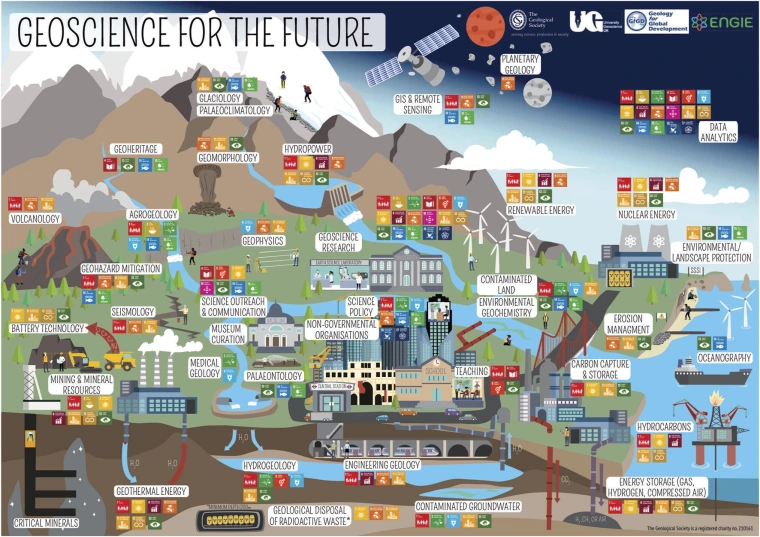
Geoscience for the Future: Sustainable Development Goals and the Geosciences: A Review by Kim Senger (Synthesis of geoscientific categories mapped to the SDGs. Figure from The Geological Society (2021), licensed under CC BY-NC-ND 4.0. Refer to Table 1 for details.)
Learn More:
The demand varies by sector but remains generally strong:
The field offers diverse career paths and remains essential for addressing major societal challenges around resources, hazards, and environmental sustainability. Talk to your advisor to learn more!
Salary Range: Entry-level positions typically start around $50,000-$70,000, with median salaries for experienced geoscientists ranging from $80,000-$100,000+, depending on sector and specialization. Petroleum geologists and those in extractive industries often earn significantly more.
Current Outlook
- The energy transition is creating demand for geoscientists skilled in geothermal energy, carbon capture and storage, and critical mineral exploration
- Growing need for expertise in water resources management due to climate change
- Increasing demand for environmental consulting and hazard assessment
- Strong hiring in mining for battery metals and critical minerals (lithium, cobalt, rare earth elements)
Employment Sectors
- Energy companies (oil/gas, geothermal, renewable energy)
- Mining and mineral exploration companies
- Environmental consulting firms
- Government agencies (USGS, EPA, state geological surveys, NASA)
- Academia and research institutions
- Engineering and construction firms
Key Trends:
- Critical minerals for technology and clean energy = high demand
- Climate resilience and hazard assessment = growing field
- Traditional oil and gas = cyclical, dependent on commodity prices
- Data science and machine learning skills = increasingly valuable
- Interdisciplinary expertise = competitive advantage
- Locate and assess natural resources (minerals, oil, gas, groundwater, geothermal energy)
- Evaluate and mitigate natural hazards (earthquakes, landslides, volcanic eruptions, floods)
- Assess environmental impacts and develop remediation strategies
- Study climate change and its effects on Earth systems
- Conduct geological mapping and subsurface imaging
- Analyze rocks, minerals, fossils, and sediments
- Use advanced technologies like remote sensing, GIS, and numerical modeling
- Petroleum/Energy Geologists: Locate oil, gas, and renewable energy resources
- Hydrogeologists: Study groundwater systems and water resources
- Environmental Geoscientists: Address contamination, remediation, and sustainability
- Geophysicists: Use physics to study Earth's interior and processes
- Economic Geologists: Explore for mineral deposits and critical materials
- Engineering Geologists: Assess geological conditions for construction and infrastructure
- Paleontologists: Study ancient life and evolutionary history
There are also some underappreciated career paths related to national security and defense such as real-time actionable Earth monitoring.
- American Association of Petroleum Geologists
- American Geosciences Institute
- American Geophysical Union
- American Institute of Physics
- American Quaternary Association
- Arizona Geological Society
- Arizona Geological Survey
- Association for Women Geoscientists
- Geological Society of America
- International Quaternary Union
- Paleontological Society
- Society of Exploration Geophysicists
- Society for Sedimentary Geology
- Society of Economic Geologists
- U.S. Geological Survey
Go to our Youtube channel to find recorded seminar/webinar events. From 2019 - 2021, we invited 3-4 Geosciences alumni to speak to undergraduate and graduate students about their time at UArizona and their own career paths.
The College of Science Career Center provides the resources and support to address the unique and changing needs and opportunities of all students in the College of Science.
Have questions? The College of Science Career Coaches are here to help! Book a 30-minute virtual or in-person appointment with the team through Handshake for 1-on-1 support with career exploration, resume & cover letter building support, interview practice & preparation, and more! Be sure to select "College of Science Career Center" when booking your appointment. Watch a video on how to book an appointment here.
Want to leverage resources to get started on your own? Visit the College of Science Career Center's student resources page.
- Equip yourself for the job and internship search with our ready-to-use templates for your Resume, CV, and Cover Letter.
- Leverage our resources to sharpen your interview skills and gain insight on building a professional network through our Science Shadows program.